
DIGITAL TWIN
Numbers that immediately catch the eye
Enable scalability with zero manual tagging effort.
99%
Reduced Manual Handling Errors
25% +
Productivity Gain
6 hrs
Hours Saved per 400 Assets
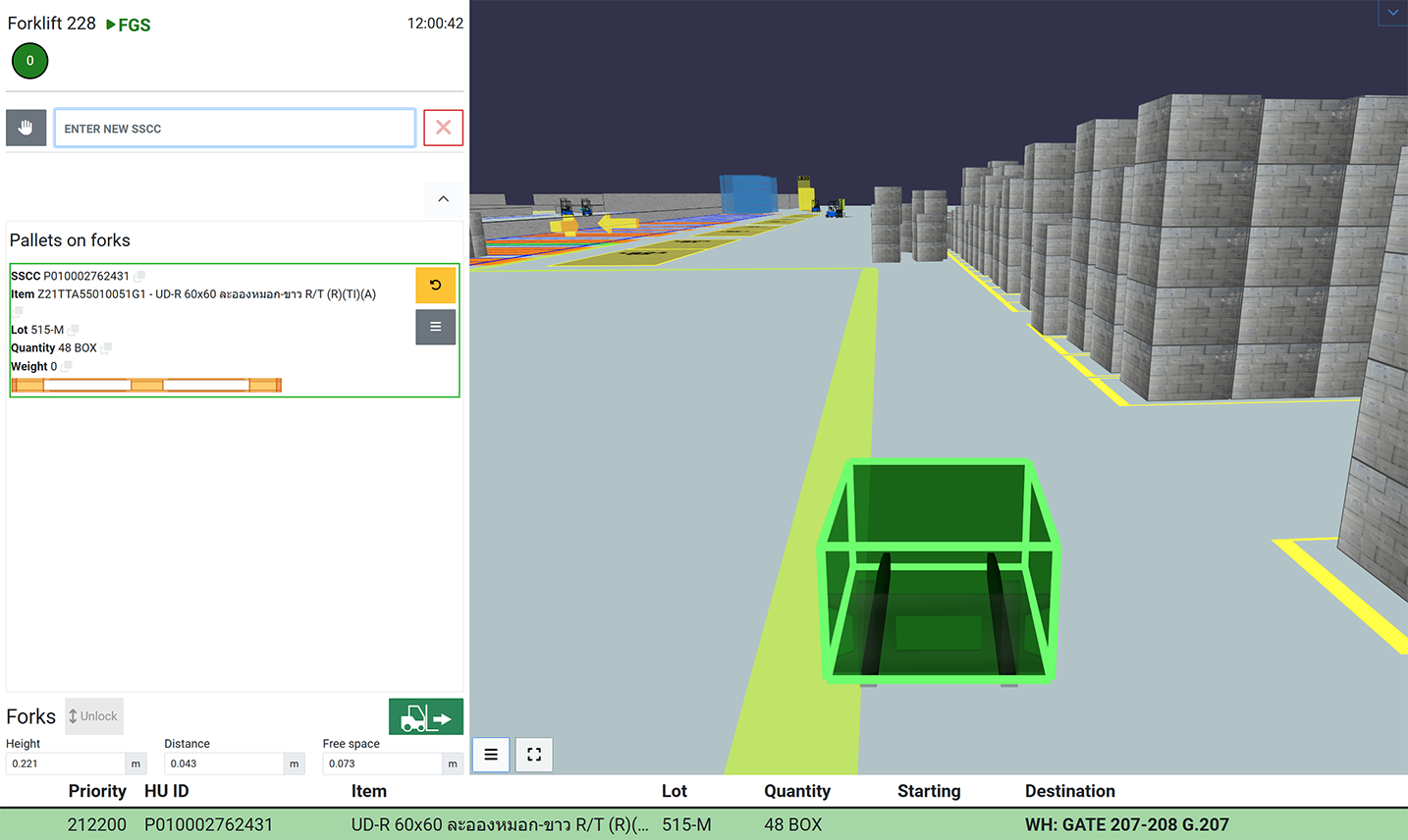
Driver View
The driver view displays a real-time 3D representation of the warehouse centered on the forklift’s position.
The screen highlights only the relevant objects for the current mission (i.e. pallets, locations, loading bays, other forklifts, etc..), giving the operator clear visual guidance, improving situational awareness and reducing the risk of navigation or handling errors.
Manager View
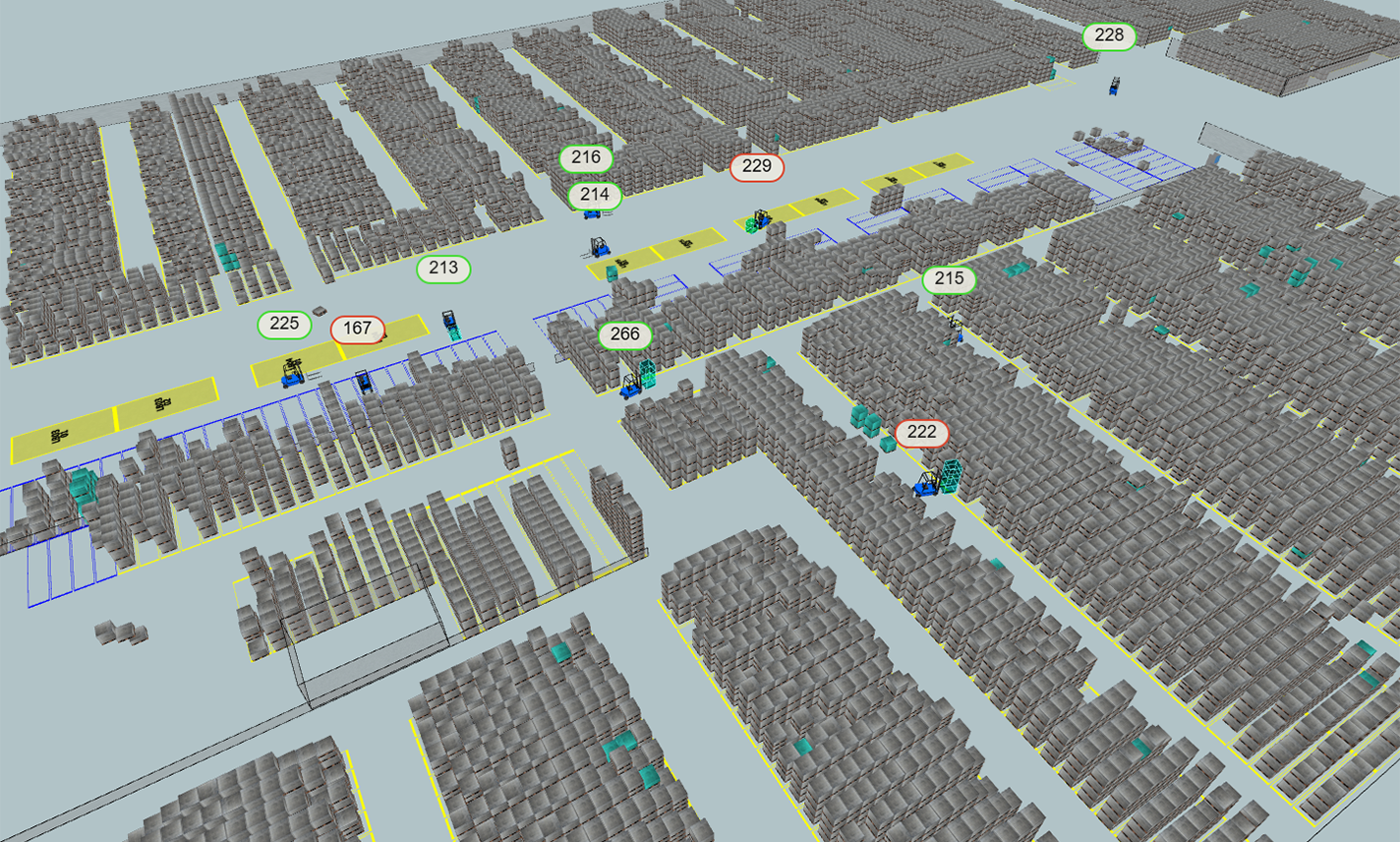
The manager view offers a broader perspective, showing the entire warehouse and the real-time position of all forklifts, pallets, and active transfer missions.
This allows supervisors to monitor operations in real time, optimize workflows based on actual conditions, and quickly react to any issues or bottlenecks before they impact overall productivity.
NAVIGATION
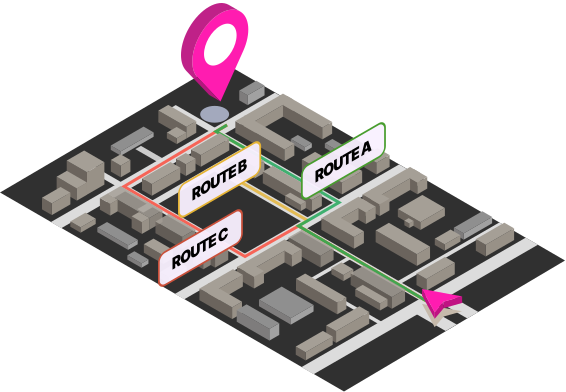
Precise direction to a clearly visible target.
It enables easy wayfinding through the navigation path, optimizes cycle time for both searching pick-up pallets (e.g., in stacked areas) and finding put-away locations, and is essential for complex warehouses and seasonal workers.
SCHEDULING
The mission schedule organized in the blink of an eye
Scheduling increases fleet efficiency by analyzing forklift flows in real time, optimizing routes, and significantly reducing empty runs, leading to measurable improvements in overall productivity.
By leveraging real-time positioning technologies and intelligent control systems, we can gain a comprehensive and dynamic view of your entire fleet and manage it collaboratively across all operational levels, transforming traffic management from a critical issue into a concrete opportunity for efficiency and cost reduction.
It is a flexible and adaptive tool, carefully applied and modeled to meet the specific needs of each individual logistics site, taking into account its unique layout, workflows, and operational constraints, thus providing the best possible performance in every situation and at every stage of the supply chain.
Furthermore, the system continuously learns from operational data, refining its algorithms over time to anticipate demand peaks, prevent congestion, and suggest proactive adjustments — ensuring that your logistics operations remain agile and future-ready in an ever-evolving industrial landscape.
AUTO-ID
A visual check that doesn’t need tags or anything else
Auto-ID generates time-savings and improved efficiencies by eliminating significant amounts of repetitive manual work.
The principles
3D Storage
Every pallet is stored with x-y-z coordinates in the 3D warehouse twin. Reliability in all types of logistics areas, especially where the use of barcodes is problematic (e.g. floor/block stacking areas).
Forklift Sensors
Dragonfly Localization + forks height and pallet presence sensors for the “Auto-Identification” of the pick-up and storage operations.
No RFID
No need for additional RFID (or BLE) tags on the pallet: traditional barcodes or QR codes are enough for a “visual” check
Scannerless
No need to scan anything when storing or picking-up pallets
No manual operations
The driver doesn’t need to enter any data to confirm the execution of logistic operations: the “auto-ID” works automatically, without any manual intervention
Picking with Auto-ID
All the incoming goods receive a Pallet ID with x-y-z position.
The forklift driver receives information via vehicular PC about the location of each pallet to be picked up.
The storage of the pallet into the 3D warehouse happens scannerless thanks to the forklift’s position andforks’ sensors.
When the forklift driver loads the pallet into the truck loading bay, the Auto- ID checks that it is an expected pallet from the Shipment data, otherwise it issues an alert.
REPORT & ANALYTICS
From sight to insight
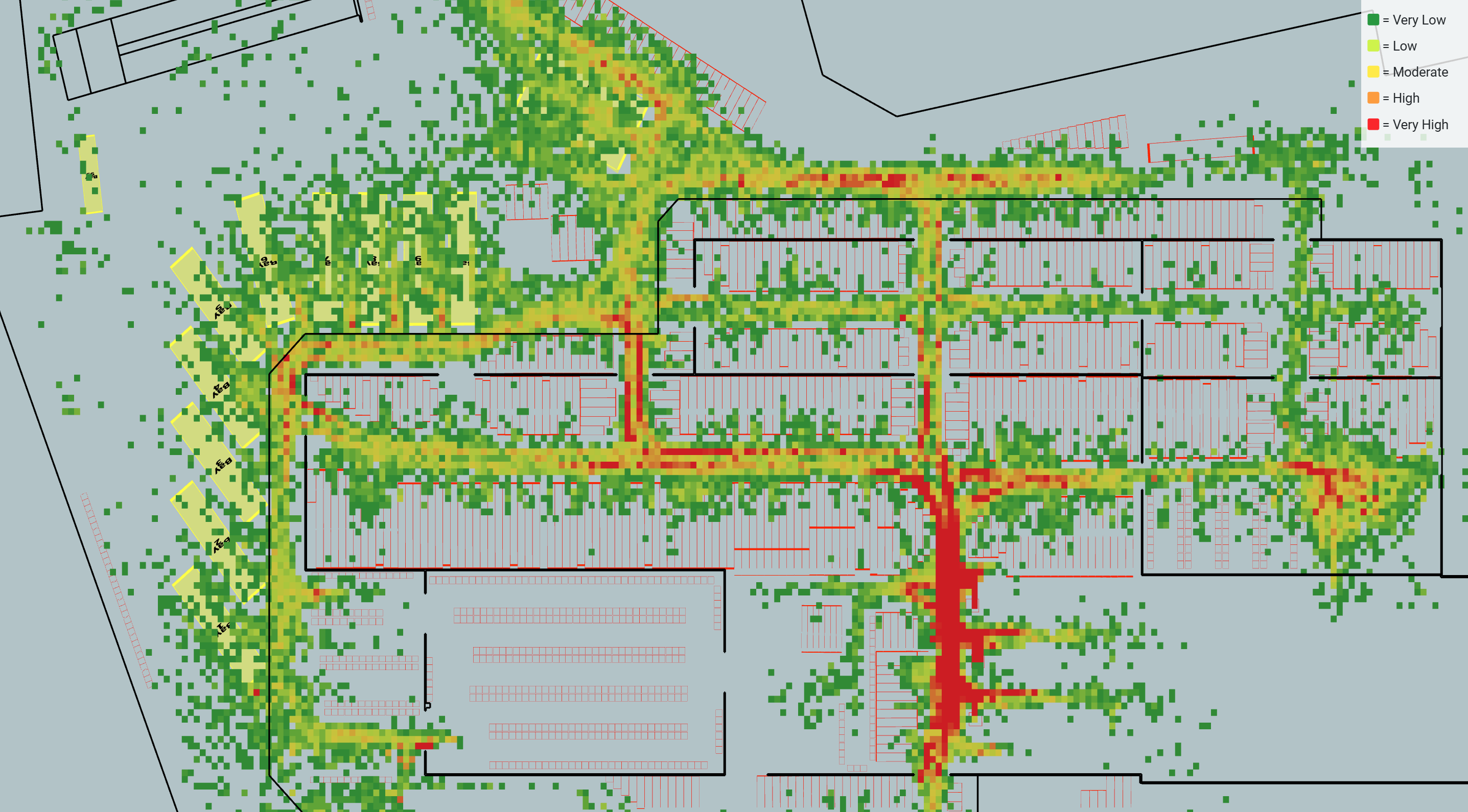
The system provide advanced analytics, heatmaps, spaghetti charts and statistics about the operation of each forklift.
It helps make a series of strategic decisions, like changing industrial truck allocation per process and logistic area, chianging drivers and roles, and redesign warehouse layout.